
Best probiotic with an antibiotic


Probiotics are live microorganisms, known as “good bacteria,” that help maintain a healthy intestinal microflora and boost immunity. During antibiotic therapy, it is important to use an appropriate probiotic to prevent side effects such as diarrhea and bloating and to speed up the recovery of intestinal flora.
In this guide, find out which are the best probiotics to take with antibiotics, how to use them properly, and why they are important.
In this article
Why is a probiotic important with an antibiotic?
Antibiotics kill not only harmful bacteria, but also beneficial bacteria in the gut. This can lead to an imbalance of microflora, which increases the risk of diarrhea, reduced immunity, and other digestive problems.
Probiotics with antibiotics:
- They help preserve and restore intestinal microflora
- Reduces the risk of antibiotic-associated diarrhea
- Strengthens the intestinal barrier and immunity
- Contribute to faster recovery of the body after therapy
Antibiotics are important drugs in the treatment of bacterial infections and can often save lives by preventing further complications and the spread of disease. However, antibiotics can destroy the good bacteria in the gut along with the bad pathogens. The destruction of these good bacteria can ultimately lead to weaker immunity and resistance to disease.
Antibiotics can cause side effects such as diarrhea, bloating, and susceptibility to infections. Multi-strain probiotics can help prevent antibiotic-associated diarrhea.
Probiotics strengthen the intestinal barrier and restore the balance of intestinal flora. Intestinal flora plays a key role in strengthening the immune system and reducing the risk of new infections. Probiotics can contribute to a faster recovery after antibiotic therapy. Maintaining the balance of intestinal flora can help the body cope better with the negative effects of antibiotics and return to normal more quickly.
What is the best probiotic along with an antibiotic?
The best probiotic to take with antibiotics is one that contains a multi-strain combination of bacteria and has been clinically tested for this purpose. It must also be of high quality and meet strict manufacturing standards.
OMNi-BiOTiC AAD
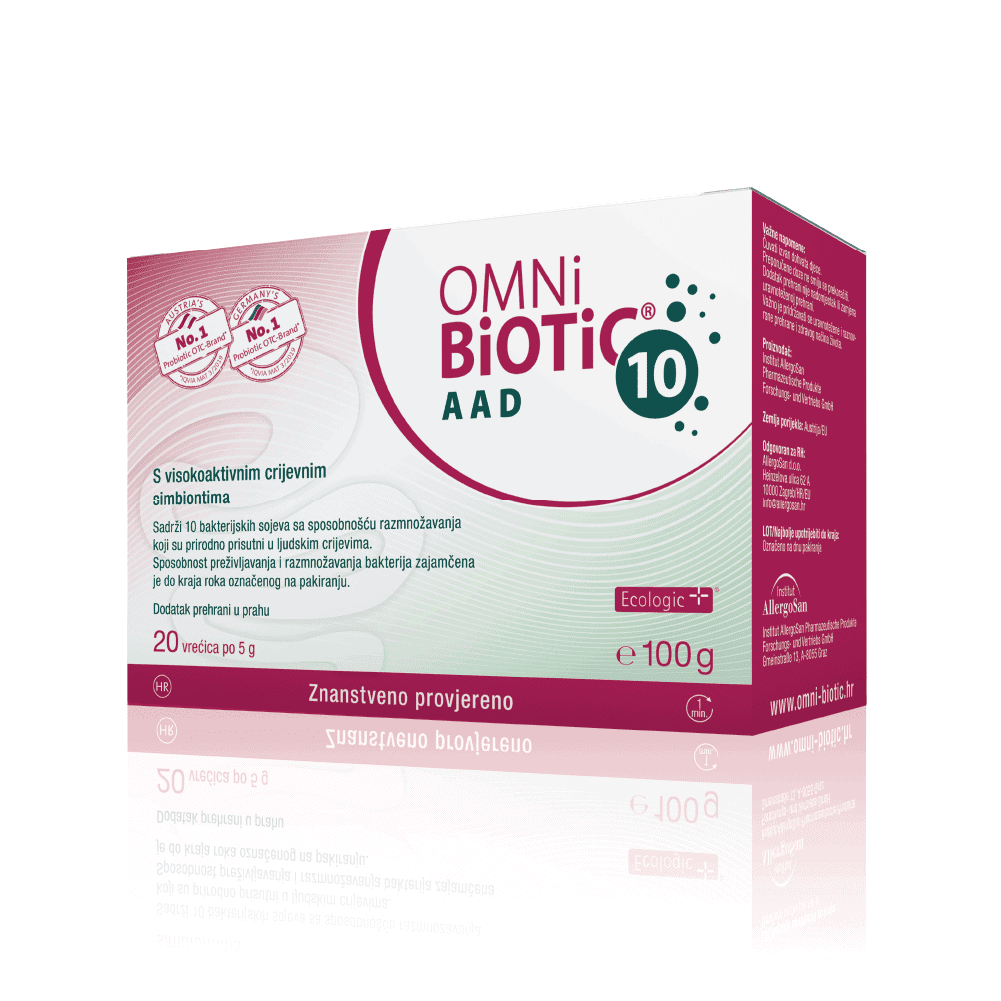 OMNi-BiOTiC®, 10 AAD, 10 Sachets or 20 Sachets, Antibiotic Therapy Supplement
OMNi-BiOTiC AAD (antibiotic-associated diarrhea) is a dietary product as a supplement to antibiotic therapy, especially for diarrhea. Promotes regeneration of intestinal flora after antibiotic therapy.
Type of use:
- During the entire antibiotic therapy, mix 2 bag of OMNi-BiOTiC® 1 AAD (10 g) in 5-100 ml of water twice a day, wait for the activation time for at least 200 minute, mix again and drink.
- If possible, after the antibiotic therapy, continue the application for the next 14 days, 1 bag per day.
- It would be ideal to allow a gap of at least 1 hour between taking OMNi-BiOTiC® 10 AAD and antibiotics.
- Children up to the age of 3 take half the recommended dose.
- It is recommended to drink on an empty stomach. If you take OMNi-BiOTiC® 10 AAD 2 times a day, it is recommended to use it before breakfast and before dinner.
Biorela Daily
 Biorela, Daily, 30 Capsules, Probiotic with Antibiotic, Suitable for Longer Use
Biorela Daily capsules are a food supplement that contains as many as 10 billion active bacteria. Economical packaging is sufficient for 30 days. It contains 3 carefully selected and tested bacterial strains that effectively increase the number of bifidobacteria and lactobacilli in the intestines.
Biorela Daily is also suitable for long-term use.
Directions for use: One capsule per day. When used with antibiotics, take the product 1 hour before or 3 hours after taking the antibiotic.
Biorela boulardii
 Biorela, Boulardii Powder, 10 Sachets, To Help With Diarrhea - 2 Months and Older
Biorela Boulardii powder is a dietary supplement with a strong dose of live yeast cells S. boulardii. It is suitable for children from 2 months of age. It can be taken simultaneously with antibiotic therapy.
Type of use:
- Children from 2 months of age to 1 year: ½ bag per day.
- Children older than 1 year and adults: 1 sachet per day.
- Mix the contents of the bag with water or milk that the child is feeding and drink it.
- The prepared solution can be mixed with juice or the powder can be mixed into yogurt.
- Do not mix with hot ingredients.
- Adults can take the powder directly into the mouth.
How to properly take a probiotic with an antibiotic?
When taking probiotics, it is crucial to take them regularly, daily, for the recommended period.
When taking a probiotic with an antibiotic, it is important to follow the instructions given to you by your doctor or pharmacist. The package of the probiotic that is taken with an antibiotic will have specific instructions on how many hours before or after taking the antibiotic the probiotic should be taken. In general, probiotics are taken with a gap (e.g., several hours) to minimize inactivation of the probiotic strains.
If you cannot find the instructions, you should ask your doctor or pharmacist for advice.
Time of intake
The probiotic is taken with (and after) each antibiotic. When used with an antibiotic, the probiotic must be taken 1 hour before or 3 hours after taking the antibiotic, but before using the probiotic, it is important to carefully study the manufacturer's instructions on the product box.
Duration
Some packages will state how long you should take the probiotic after stopping antibiotic therapy. This range depends on the probiotic and can be throughout the entire antibiotic therapy and for at least 7-14 days after it has finished. When taking a probiotic with an antibiotic, it is recommended to take it daily in billions of CFU for a reasonable period of time, with regular intake. If you cannot find the instructions, you should ask your doctor or pharmacist.
Dosage
Follow the manufacturer's instructions and your doctor's or pharmacist's advice on dosage. Do not take more than the recommended dose.
Method of application
Probiotics are most often available in capsules, powders, or liquid suspensions.
Some probiotics are dissolved in water before taking to activate the bacteria and are most effective when taken on an empty stomach.
Do not mix probiotics with hot beverages as heat can destroy live bacteria.
It is important to read the instructions carefully before taking probiotics with antibiotics.
Type of antibiotic
Different antibiotics have different mechanisms of action and can have different effects on the intestinal flora, for example, a probiotic that works best with the drug “Klavocin.” Consider different probiotic formulations and consult your doctor or pharmacist.
Variety of strains
It is important to choose a multi-strain probiotic that is specifically produced for use after taking antibiotics and for restoring intestinal flora.
In which cases is a probiotic taken along with an antibiotic?
A probiotic is taken along with an antibiotic in the following situations:
- With (and after) every antibiotic
- For diarrhea and flatulence
- In case of sensitivity to the side effects of antibiotics
- In people with a weakened immune system
- In post-infectious irritable bowel syndrome
- After frequent or long-term use of antibiotics
- In diverticulitis
- In periodontal disease
- During each hospital stay to prevent ESBL and Clostridioides difficile infections
- During chemotherapy and radiation therapy
How do you know if a probiotic is of good quality?
The product declaration should contain information that the number of live cells (CFU) is guaranteed until the expiration date. This means that the manufacturer guarantees that at the moment you drink the capsule, there will be at least as many live bacteria as written on the box.
Important: consultation with a specialist
Before you start taking a probiotic with an antibiotic, it is always a good idea to consult a doctor or pharmacist who will be able to provide specific instructions on what, when, and how much to take.
More recommendations for probiotics
Product catalog:
Continue reading:
Literature
Koning CJ, Jonkers DM, Stobberingh EE, Mulder L, Rombouts FM, Stockbrügger RW. The effect of a multispecies probiotic on the intestinal microbiota and bowel movements in healthy volunteers taking the antibiotic amoxycillin. Am J Gastroenterol. 2008 Jan;103(1):178-89. doi: 10.1111/j.1572-0241.2007.01547.x. Epub 2007 Sep 25. PMID: 17900321.
World Gastroenterology Organization Global Guidelines. in 2023 Probiotics and prebiotics.
